
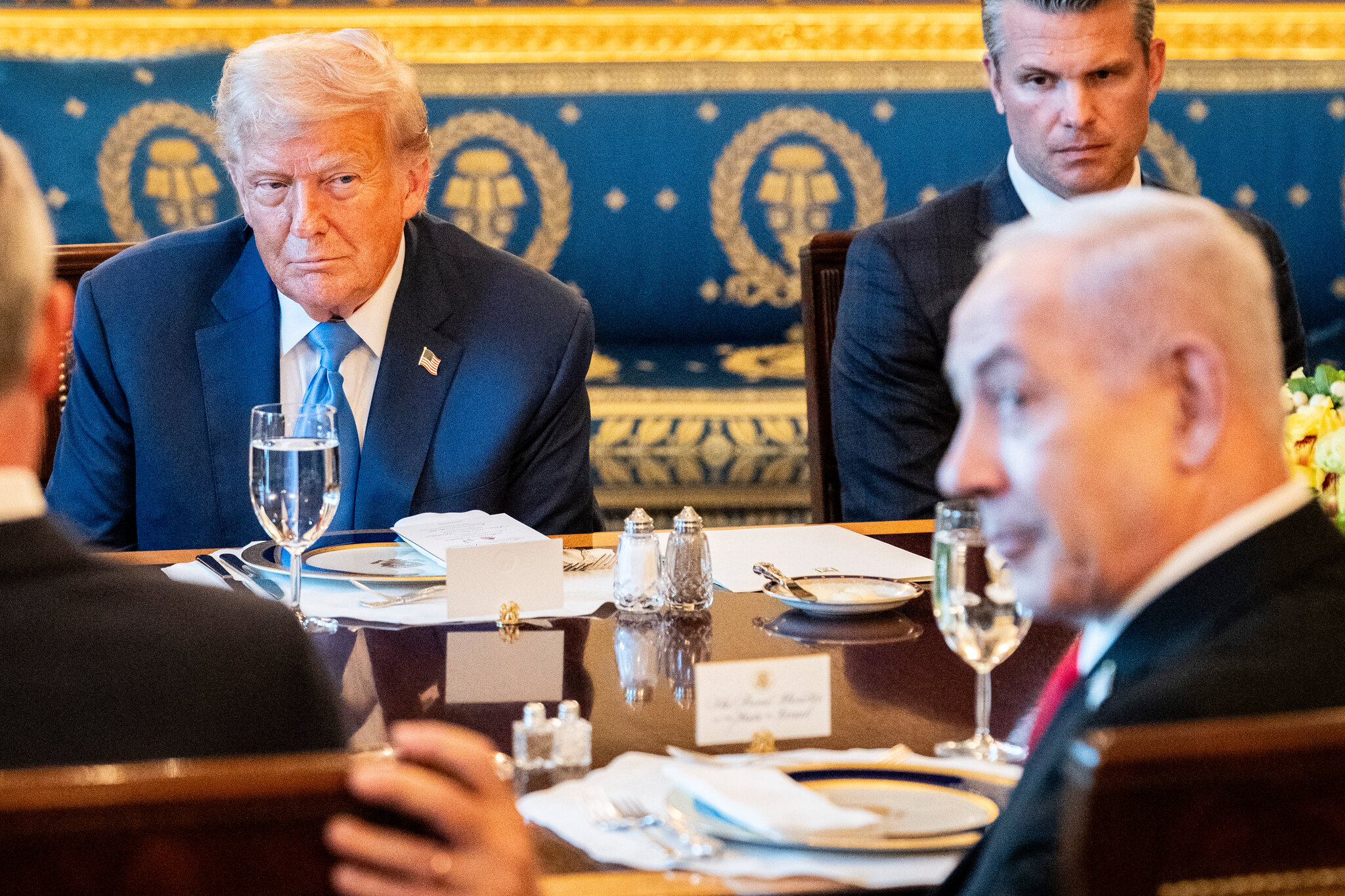
The limited press opportunity and overall lack of ceremony signaled that Netanyahu’s meeting with Trump was not for show, but for business.
Jpost
Often, when an Israeli prime minister visits Washington, the visit itself is the message – the Oval Office photo op, the handshake, the exchange of platitudes.
The image beamed around the world – the leader of the Jewish state sitting beside the president of the United States in front of the iconic fireplace – sends a message of partnership. Sometimes, it’s meant to signal adversaries, sometimes allies, and sometimes to reassure domestic audiences. But the public display in the Oval Office is part of the point.
That’s why Prime Minister Benjamin Netanyahu’s current visit to Washington – and his meeting with President Donald Trump on Monday evening – felt so different.
There was no photo-op in the Oval Office, no joint press conference. Instead, the leaders, along with their senior teams, met over dinner in the Blue Room. Netanyahu, unusual for this kind of policy meeting, was joined by his wife, Sara and Melania Trump wasn’t there.
The White House press corps was allowed in the room beforehand to ask a few questions.
The Israeli traveling press corps, however, was excluded – a highly unusual move.
The low-key nature of that first meeting suggested that this time, substance took precedence over optics — a sense reinforced by a second follow-up meeting scheduled for Tuesday evening, something that rarely happens during prime ministerial visits to Washington.
In recent memory, there have been only a handful of occasions when a visit to Washington by an Israeli prime minister did not include an Oval Office photo-op with both the American and Israeli press.
One was an early 2010 meeting between Netanyahu and then-president Barack Obama, held shortly after Israel announced new housing construction in east Jerusalem during Vice President Joe Biden’s visit. That meeting was famously tense and included a dinner Obama held with his family, during which time Netanyahu was left waiting in a side room.
Another instance came in March 2015, when Netanyahu visited Washington to address a joint session of Congress to denounce the Iran nuclear deal. Not only was there no Oval Office photo-op, there wasn’t even a meeting – an historic snub from a furious Obama.
Both of those instances occurred at low points in US-Israel relations.
Low-profile meeting considered a high-water mark
But this week’s low-profile meeting took place at what might be considered a high-water mark. It came just weeks after the US, working in tight coordination with Israel, bombed three Iranian nuclear sites, setting the program back by what Israeli and American officials believe could be years.
SO, WHY the somewhat dimmed spotlight?
There are several possible explanations.
First, the timing. The visit came at a critical diplomatic juncture, both in terms of the indirect Israel-Hamas negotiations underway in Qatar over a Gaza ceasefire and hostage deal, and with US-Iran talks expected to restart shortly. The stakes are extremely high in both arenas. Public posturing or making the wrong statement could derail delicate talks. So why take that risk?
Second, some issues are best handled behind closed doors…
Sensitive topics – such as military coordination, redlines on Iran, or sensitive trade-offs with Hamas – demand discretion, candor, and creative thinking, all of which are better achieved in low-profile meetings.
Third, the quieter format may have been deliberately chosen to convey the seriousness of the moment. Unlike what many assumed, that Netanyahu was flying to Washington for a diplomatic victory lap after Israel’s operation in Iran, the meeting projected determination, not celebration. The lack of pomp and circumstance suggested the leaders were more focused on deliverables than optics: a ceasefire in Gaza, hostage releases, and new regional arrangements.
The format also sent a message to regional players – Hamas, Iran, and Arab states – that Washington and Jerusalem are engaged in genuine high-level coordination, not merely staging scenes for domestic audiences.
And there’s another layer to this: control. By excluding the Israeli press corps, Trump was able to shape the narrative through choosing familiar reporters to ask questions for 30 minutes before the talks over dinner began. He also was less likely to get entangled in Israeli domestic politics, and – indeed – was not asked by the US press corps the question Israeli journalists almost certainly would have raised: his call for Israel to end Netanyahu’s trial.
The limited press opportunity and overall lack of ceremony signaled that this meeting was not for show but for business.