
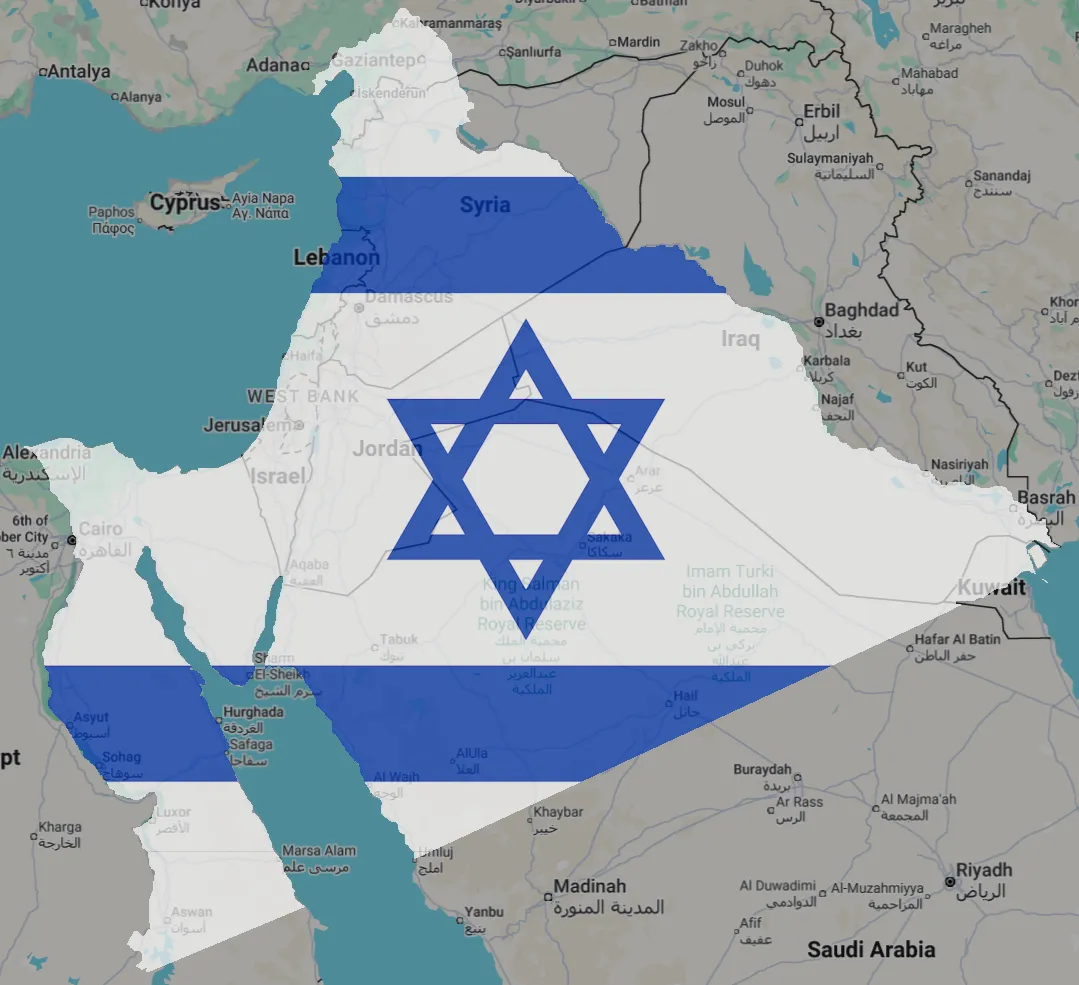
Israel is signaling its intent to escalate its military and intelligence campaigns inside Syria, as its honeymoon phase with the new administration comes to an end.
Since the fall of the previous government in Syria in December 2024, the terrorist Jewish State has managed to carve out 400 square kilometers of territory in the south of the country, bomb the nation at will, and carry out its invasion, whilst managing to hold direct meetings with senior officials in Damascus.
However, the new Syrian state has quickly become a hub for competing regional and world powers to extract their desired outcomes.
The Israeli invasion of Syria has led to the occupation of more territory, making more gains than ever before, and without having to fight to capture the land. The only opposition has come from isolated cases of local fighters who choose to either launch projectiles or set up ambushes for the occupying army.
Meanwhile, the government of Ahmed al-Shara’a has not even dared to issue threats of armed retaliation, even after the murder of hundreds of Syrians in July 2025 Israeli airstrikes, which destroyed the Ministry of Defense. For its part, the government has attempted to make it clear that it has no interest in fighting Israel.
Despite this, the Israelis have sought to involve themselves in internecine sectarian conflicts, arming Druze separatist militias in the south and even demanding the establishment of a land-bridge between Israeli-occupied territory and Sweida in southern Syria.
Using any available pretext, Israel regularly launches deadly airstrikes and directly threatens the Syrian leadership.
Israel Shifts Its Mentality
It had appeared previously that Tel Aviv was open to reaching a so-called ‘security agreement’ with Damascus, yet, after several rounds at the negotiating table, it decided to walk away, no surprise. The real problem with such talks was that the Syrian side had already given away all its leverage before it entered discussions, so naturally the Israelis came in with their usual maximalist demands and sought to achieve a deal which would ‘legalize’ their occupation and freedom of action across the country.
For some time, the Israeli military has operated under the impression that no immediate threat to it could be posed from the Syrian front. This was not only down to the destruction of most of Syria’s strategic arsenal and disbanding of the Syrian Arab Army (SAA), but also because it had become clear that al-Shara’a was depending upon the United States.
In order for al-Shara’a to stay in the good books of the US government, he knew that the requirement would be to play ball – meaning more than being filmed playing basketball with CENTCOM officials. The Syrian administration is working alongside the US military to target specific figures and armed cells in the country, to stop weapons shipments to Hezbollah and ensure there is no threat to Israel.
As time has passed, it has become clear that the country’s economy is still on the floor. Unemployment is estimated to remain at over 60%, poverty rates at around 90%, and corruption has taken hold through a ‘shadow governance’ model. Any improvements have been overshadowed by the grievances of various groups, including militias who formerly fought on the side of al-Sharaa’s Hayat Tahrir al-Sham.
When the talks between Damascus and Tel Aviv broke down, the rhetoric from Israeli think-tanks, politicians, and media began to shift against the current administration. Alma, an Israeli think-tank that focuses on the northern front with Lebanon and Syria, began talking about the weakness of the regime in Damascus, anticipating its potential fall at any moment.
On December 8, as some Syrians launched demonstrations celebrating one year since the fall of Bashar al-Assad, Alma published a new article, claiming that the new Syrian leader is engaging in ‘Jihadist pragmatism,’ opposed to ‘Western pragmatism’ to explain his diplomatic moves since taking power. It argues that al-Shara’a’s closeness to the US and Israel comes as part of a long-term ‘Al-Qaeda plot’.
As implausible as this sounds, what can be understood from the analysis of the strategy pursued by al-Sharaa is that the Israelis have decided it is time to flip the script and use the Syrian president’s past as a means of justifying further aggression against Syria.
To be clear, there are countless militant groups, some of which have been integrated within the new Syrian security state, which are ideologically committed to Al-Qaeda’s doctrine. It is also true that al-Sharaa comes from this background, having previously assumed senior positions in ISIS and Al-Qaeda.
Where this argument falls flat however, regarding the secret ‘Al-Qaeda plot’, is that there is not a shred of evidence to support claims that both the US and Israel are being played by the Syrian president.
Basing the decision to go to war on this kind of theory alone is not what any government does, so, while this may be the propaganda strategy, it clearly does not reflect the belief of the Israeli leadership.
Instead, they seek to make tactical gains inside Syria, and it appears that either toppling the current Syrian administration or severely weakening its military capabilities is now in the books.
Escalations on the Ground
Factors on the ground appear to be contributing to this new Israeli approach.
One of these is the recent ambush on its forces in the village of Beit Jinn, which led to the injury of a number of soldiers and the murder of around 13 Syrians. This led to public chants against Israel and gatherings where the Israeli flag was burned.
On December 8, Syrian military formations were then filmed chanting for Gaza. In other instances, uniformed fighters were filmed shouting ‘Khaybar, Khaybar, a yahoud,’ referencing the historic battle between the Muslims and Jews of Khaybar, defeated by the Prophet of Islam’s army. Another incident that went viral on social media featured fighters above Damascus using parachute gliders, like those utilized by Palestinian fighters on October 7, 2023.
These videos caused an enormous stir among Israelis, resulting in officials threatening military action. Israeli Diaspora Affairs Minister Amichai Chikli commented that ‘war is inevitable’ on X (formerly Twitter).
Although provocative chants and other stirrings reflecting Syria’s overwhelming public opposition to Israel, there are still no signs of an impending Syrian military assault in response to Israel’s ongoing invasion. Regardless, the Israeli public expects military action.
Former Israeli Ambassador to the US Michael Herzog spoke a month ago at a conference hosted by the Washington Institute for Near East Policy (WINEP), where he spoke about the fear of Syrian armed groups posing a threat to Israel. Herzog stated that, while Hamas in Gaza was allowed to build itself into a force that caught the Israeli military ‘off guard’ on October 7, Israel would not make a similar mistake of allowing Syrian groups to do the same. He also lamented Turkiye’s role in Syria.
An Israeli War on Syria?
The first thing to note when attempting to predict the future of the Syria-Israel conflict is that a war is already in progress, despite the Syrian side not responding, and the process of Israeli gains occurring at a slow pace.
Fundamentally, addressing this subject must be premised on the fact that Syria is under attack and occupation, not the other way around. Syria also has the right to retaliate and defend its sovereignty, so too do independent militias, which are formed of those living under occupation or are attacked by Israeli forces.
Nevertheless, there is logic to the idea that Syrian armed groups may begin forming a resistance front against Israel: intent is there, popular support exists to back it, and, if the Israelis continue their invasion, resistance is inevitable.
In short, Israel’s invasion and occupation means forcing this reality upon itself.
As the government in Damascus has demonstrated, it is willing to break all Syrian political traditions and be accused of being traitors, just to meet Israeli officials face-to-face. Yet, despite al-Sharaa’s intentions toward steering clear of war with Israel, it simply is not his choice. His popularity remains high among a dominant section of Syrians, but is certainly falling. Al-Sharaa has also made many enemies, and it is clear he cannot fully control the armed groups that are supposedly under his control. The reality of his government’s weakness has repeatedly placed the nation on a knife-edge throughout the past year.
In other words, if Israel chooses escalation and Syrian armed groups respond, there is little al-Sharaa can do to avoid leading an opposition to Israeli warmongering. Israel could choose to assassinate the Syrian leader, knowing that such a move would quickly lead to a power struggle, triggering bloody street battles between rival factions and a series of score-settling assaults across the country. Such an act would more likely be committed on the ground rather than via airstrikes.
If the Syrian president is murdered and a power struggle ensues, Israel will likely advance much further into the country. The primary goals would include seizing more territory in the Damascus countryside, carving out a land-bridge to Sweida, and planting the Israeli flag in the Syrian Capital.
If the country is embroiled in internal chaos, these goals could be achieved with little resistance and would be held up as a major victory by the Israeli government.
Reading this, some may ask why the Syrian leadership does not get ahead of events by adopting a policy of responding to Israel. Assuming that there is any willingness at all to commit to such action, al-Sharaa knows that he is surrounded at all times by spies; the CIA, Mossad, MI6, and others monitor his every move.
This means that, should Israel seek to launch a decapitation strike, this would be relatively easy.
Syria’s current leadership immediately allied itself with the US, Britain, and their Western partners, meaning that sovereignty was impossible from day one of the new regime. These Western nations poured billions of dollars into regime change in Damascus, not because they were concerned about Bashar al-Assad’s behavior domestically, but because his government allied itself with Iran and other resistance forces hostile to Israel.
The only hope that things can be contained is that the weight of Turkiye’s involvement in Syria could end up deterring the sort of chaos that Israel could inflict. Ankara now has a massive stake in the country and seeks a stable border, but also to win the competition that is emerging between it and the Israelis there.
If it were not for Turkish involvement, the Israelis would have likely already escalated.