
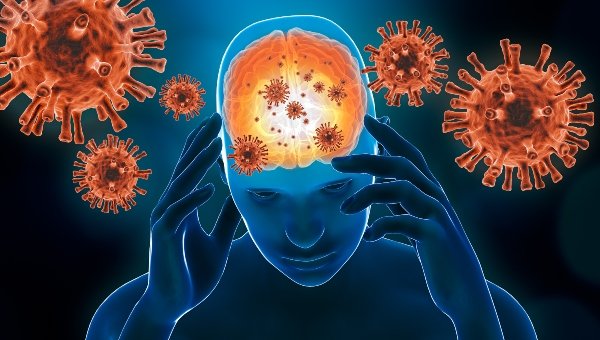
A new documentary examines how three doctors at a hospital in Rome shielded a group of Jews from the Nazis by fabricating a fake infectious disease called ‘Syndrome K’
ed note–before we jump into this, a few important quotes that need to be considered here, the first one coming from Victor Ostrovsky, former Mossad agent who writes in his book ‘The Other Side of Deception’ the following–
It was Uri who enlightened me regarding the Nes Ziyyona facility. It was, he said, ‘an ABC warfare laboratory – ABC standing for atomic, bacteriological, and chemical. It was where our top epidemiological scientists were developing various doomsday machines.’ Because we were so vulnerable and would not have a second chance should there be an all-out war in which this type of weapon would be needed, there was no room for error.
Palestinian infiltrators came in handy in this regard. As human guinea pigs, they could make sure the weapons the scientists were developing worked properly and could verify how fast they worked and make them even more efficient.
Years later, I met Uri again. He had come back from an assignment in South Africa. I was then a temporary desk man in the Dardasim department in liaison, helping him prepare for a large shipment of medication to South Africa to accompany several Israeli doctors who were headed for some humanitarian work in Soweto, a black township outside Johannesburg.
‘What is the Mossad doing giving humanitarian assistance to blacks in Soweto?’ I remember asking him. There was no logic to it; no short-term political gain (which was the way the Mossad operated) or any visible monetary advantage.’
‘Do you remember Nes Ziyyona?’ His question sent shivers up my spine. I nodded.
‘This is very much the same. We’re testing both new infectious diseases and new medication that can’t be tested on humans in Israel for several of the Israeli medicine manufacturers. This will tell them whether they’re on the right track, saving them millions in research.’
The other quotes are links to articles previously appearing in this website during the run-up to Donald Trump’s election and the subsequent 4 years of his term which the reader is invited to read at their own leisure–
Former head of the CIA compares Trump’s immigration policies to Nazi Germany
How Trump and the Nazis Stole Christmas to Promote White Nationalism
Sen. Schumer Attacks Trump for ‘Not Honoring the Six Million Jews Murdered by the Nazis’
Trump’s ‘America First’ Speech Reminiscent of Nazi Era
GOP megadonor likens Trump policies to Nazi Germany
Sarah Silverman, Dressed as Hitler, Takes Poke at Trump
Ex-ADL chief: Trump’s ‘raise your hand’ gambit was deliberate, Nazi-style ‘fascist gesture’
There are literally HUNDREDS of articles on this site alone dealing with the manner in which the followers of Judah-ism, the ‘Children of Israel’ as they love to refer to themselves, revile DJT and cast him–as they always do ALL of their enemies–as ‘the new Hitler’.
Besides the articles, there are ‘visuals’ that have attended every single political gathering where ‘they’ have coagulated to protest against DJT that should be considered as well–
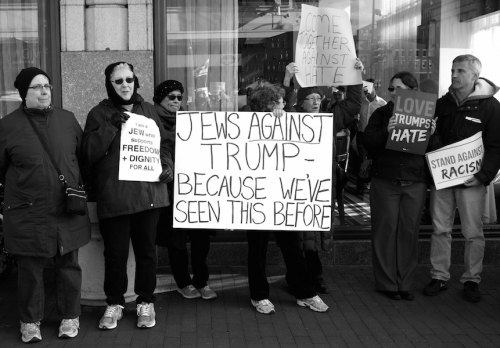
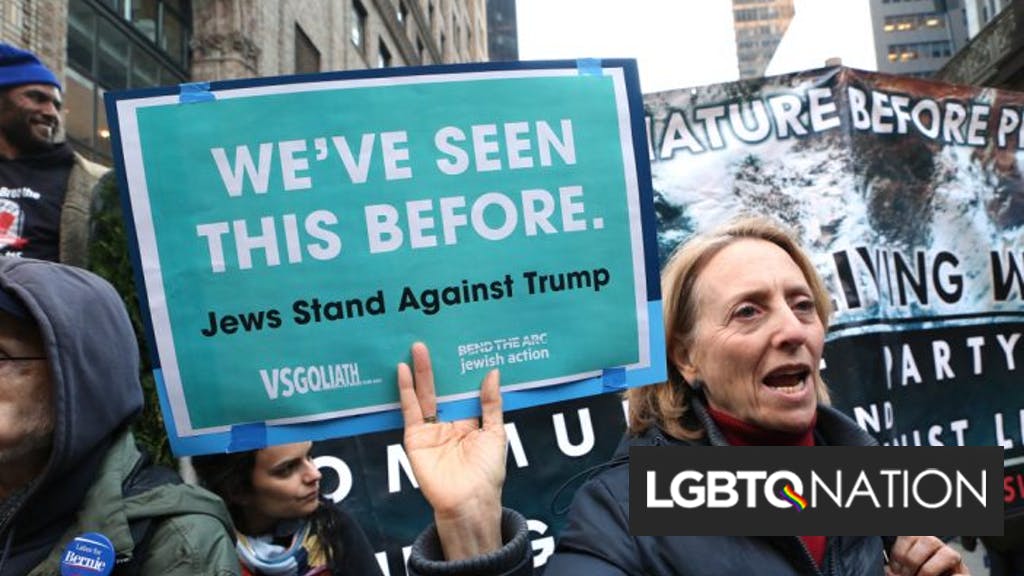
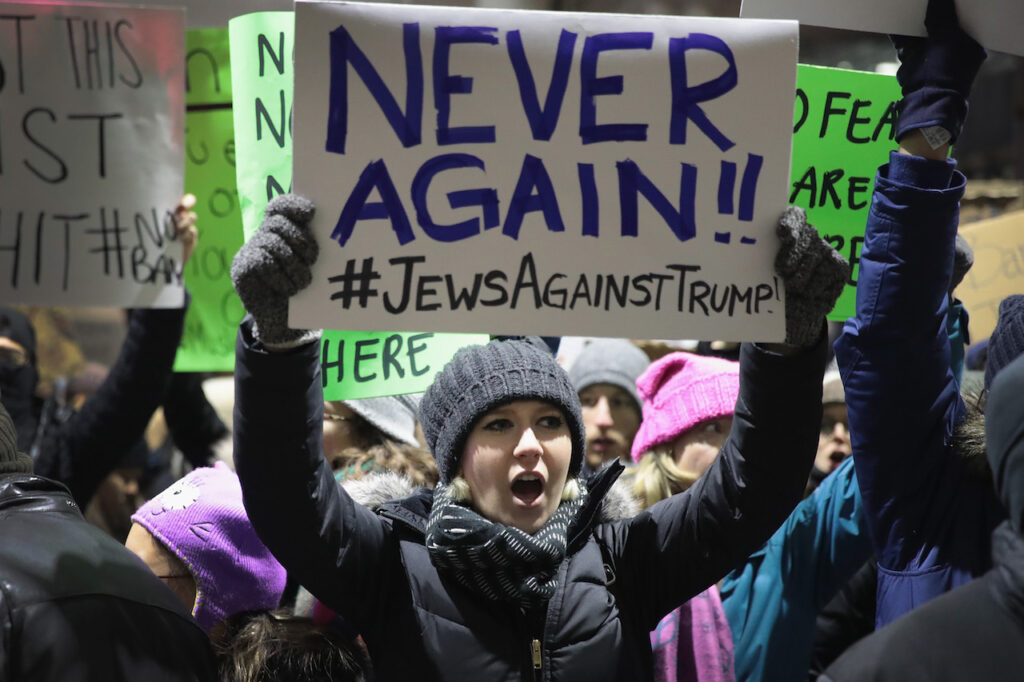
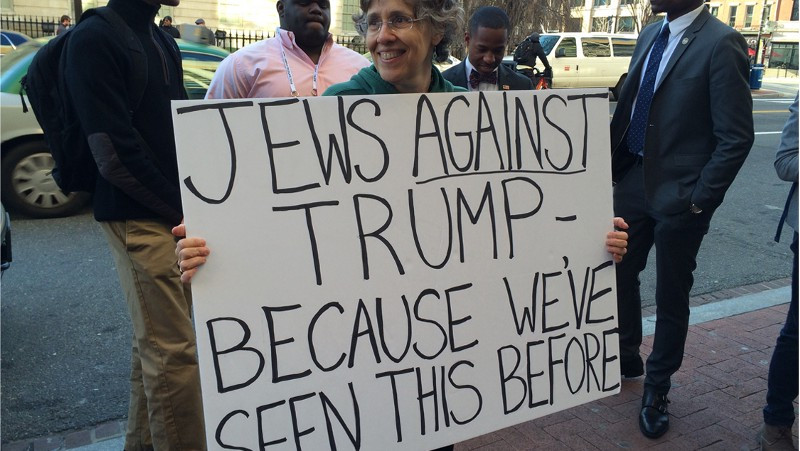
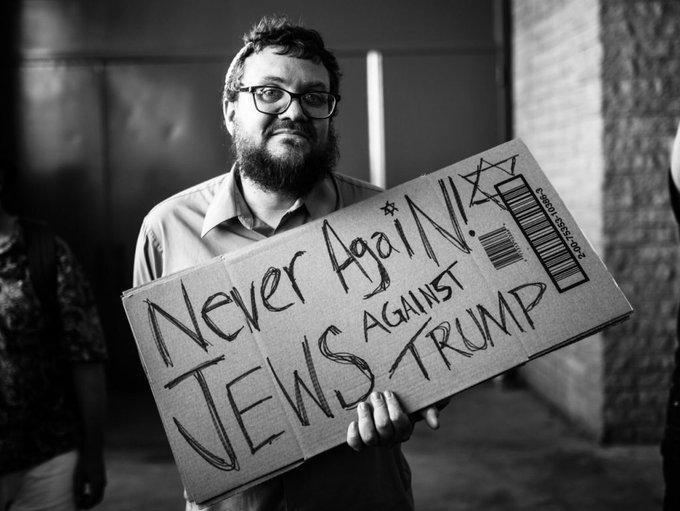
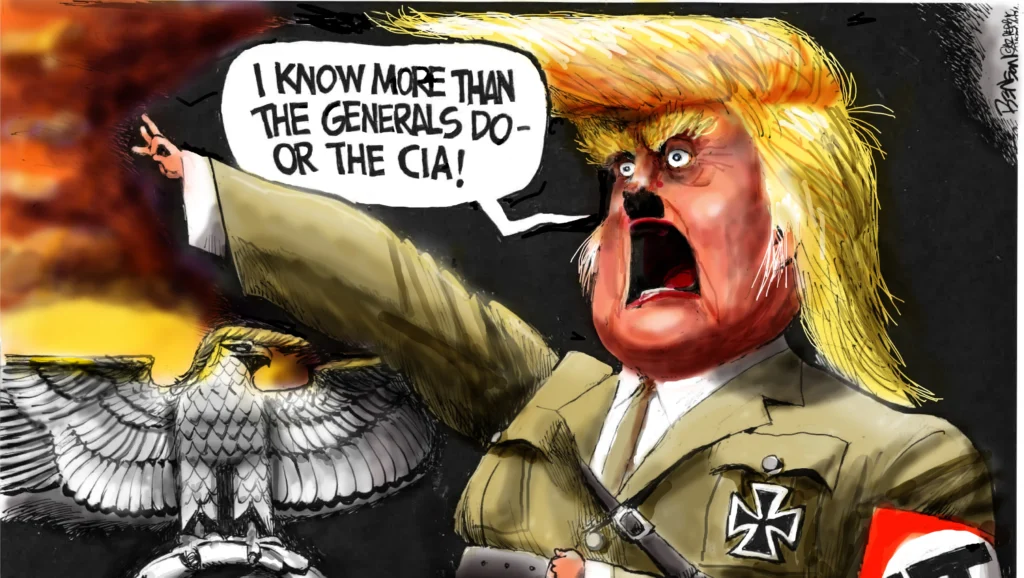
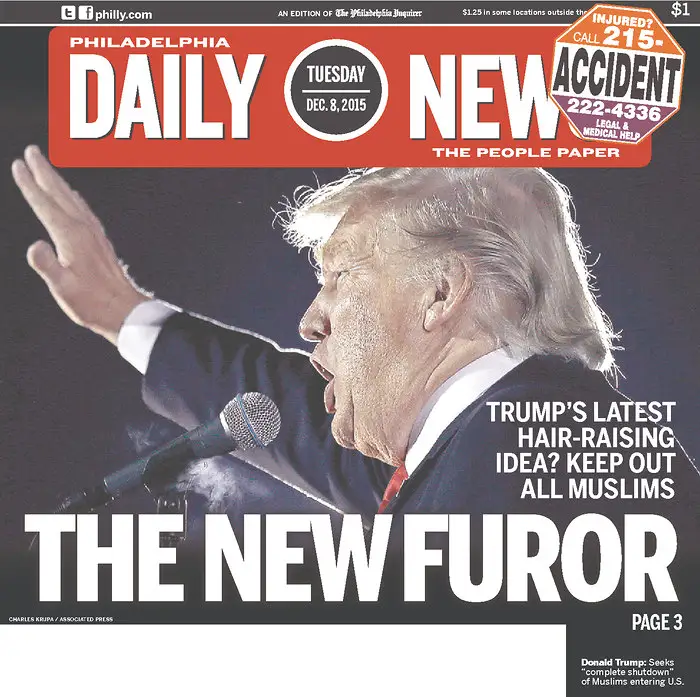
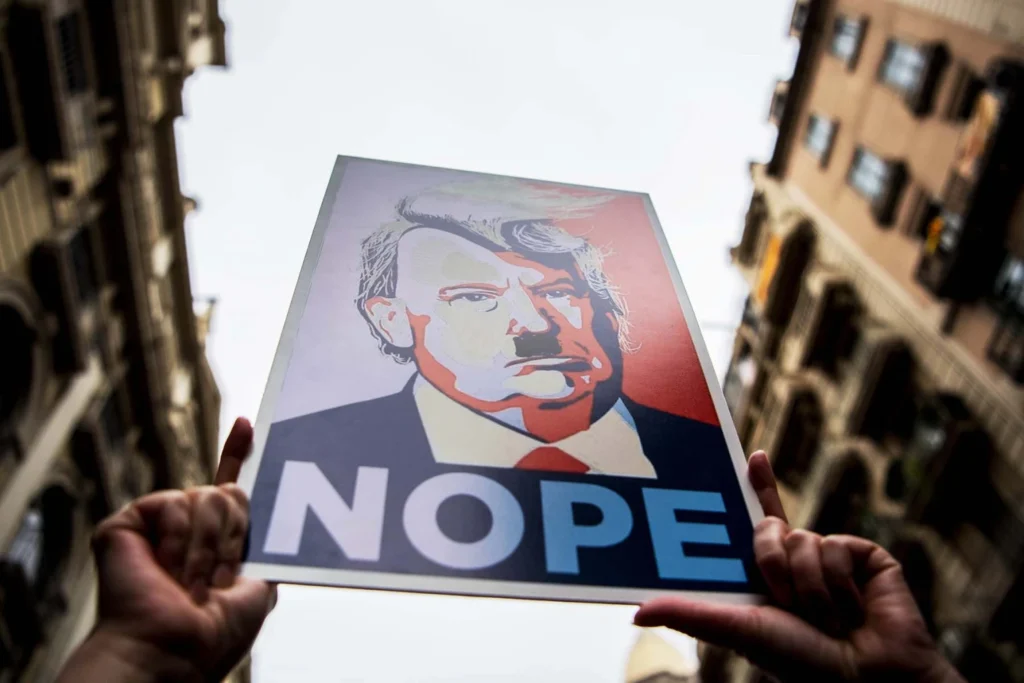
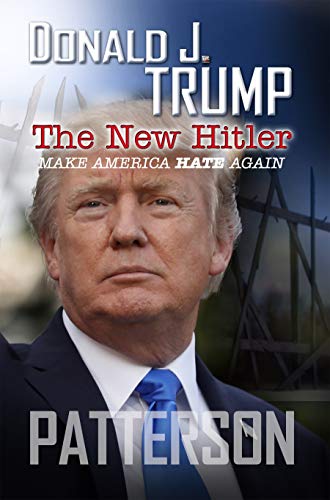
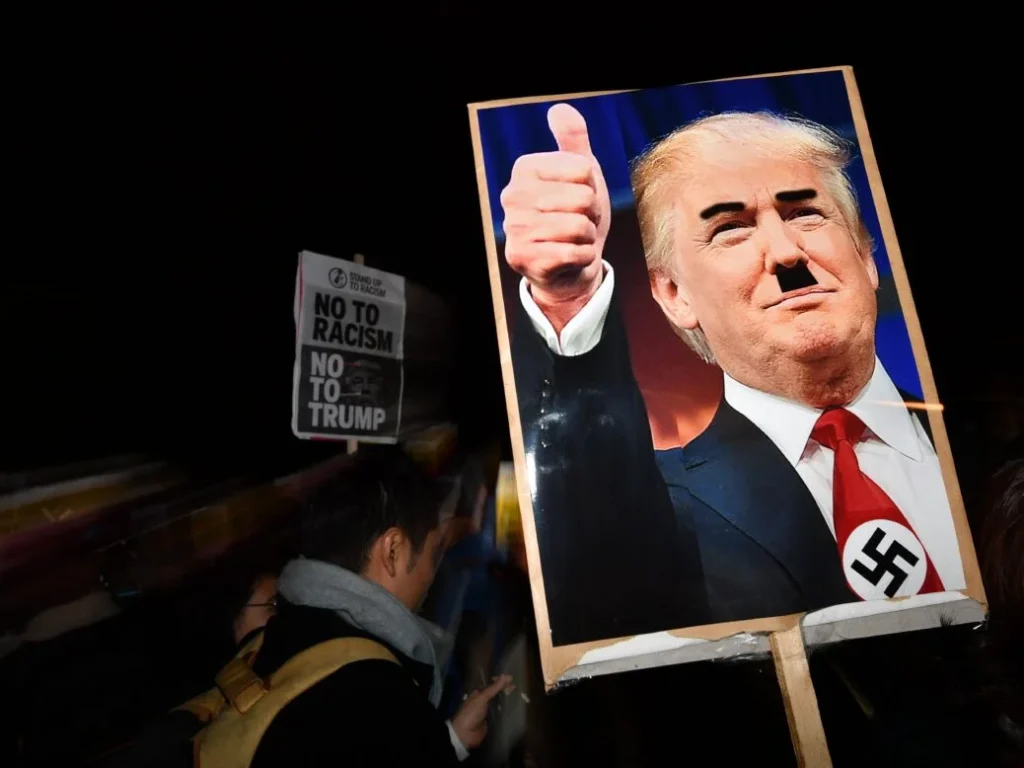
Again, we could show hundreds, thousands, tens of thousands of pics cut from the same ‘meme’, but the reader gets the point–The Jews as a group view Trump as the ‘New Hitler’ who must be stopped.
Now, obviously to some degree, they have succeeded in this endeavor, as he is out of the White House via the agency of a stolen election, but what must be remembered is that the stolen election would not have been made possible were it not for this–
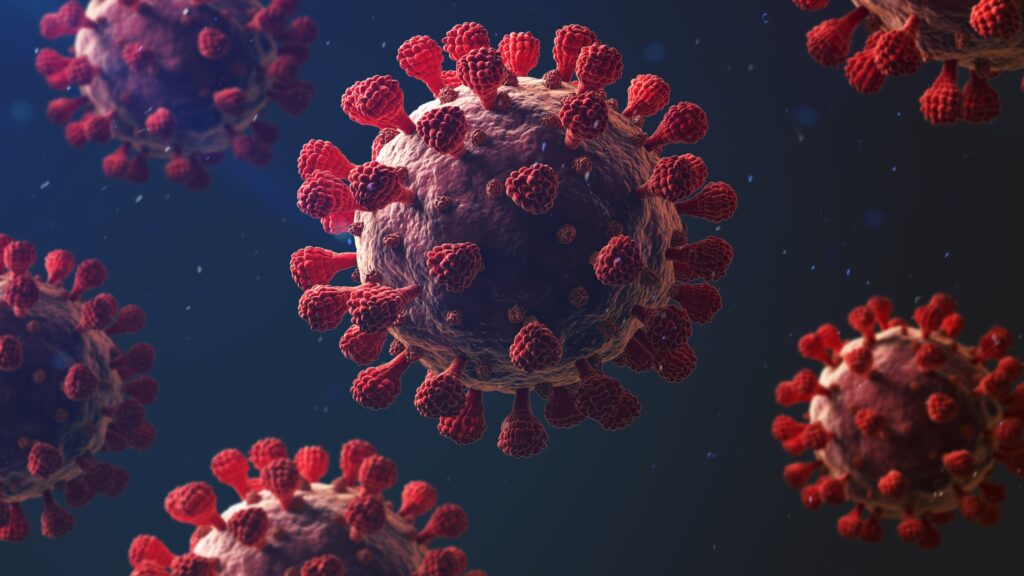
That just so happened to ‘pop up’ within literally just a few days of DJT hosting Netanyahu at the White House for this–

–That we now know via the agency of Trump’s son-in-law Jared Kushner (privy to the most intimate details of the behind-the-scenes relationship between DJT and Netanyahu) that the ‘bromance’ between the 2 leaders was not as rosy or as cozy as people had been led to believe.
In fact, as we now know from no less an ‘inside’ source as Kushner himself, Trump viewed Netanyahu as the primary reason for all the unrest and violence in the Middle East and told him so in no uncertain terms.
SO, the obvious question that needs to be discussed, and particularly in light of the particulars appearing in the story below detailing how a group of doctors ‘faked’ an infectious disease in order to ‘save Jews from the Nazis’, is how much the emergence of Covid during the 2020 election year (that was the primary reason aside from the election theft itself for DJT being run out of the White House) was in fact a replay of what took place during WWII, albeit on a much larger scale.
Please pay careful note to the very last line of the news piece itself–
Making a movie about a fake disease in the middle of a pandemic is just so ironic…
Please note as well how the article reveals the fact that this particular event has up to this point received NO discussion amidst the millions of words printed, spoken, broadcast, etc, etc, etc, concerning the Hollerco$t and all the lore and lyric associated with it, suggesting/indicating that as far back as WWII and its immediate aftermath, the followers of Judah-ism, the ‘children of Israel’ as they love to refer to themselves, were ‘making plans’ for much later…
Haaretz
How the subject of his new documentary, ‘Syndrome K,’ has largely escaped public attention is a mystery to filmmaker Stephen Edwards.
‘It’s the greatest elevator pitch in Hollywood,’ he said. ‘The story of three doctors, one of them Jewish, practicing with a fake identity, that fool the SS with a fake disease that saved Jews from certain deportation.’
‘Syndrome K,’ which hits digital and VOD platforms on Tuesday after some Jewish film festival showings, tells that little-known, surefire story: How three doctors at a hospital in Rome shielded a group of Jews from the Nazis in 1943 and 1944 by inventing a fake infectious disease called Syndrome K. The prospect of catching the disease kept the Nazis, who were occupying Rome following the fall of Mussolini, away from the hospital. The Jews there hung on until the Allies liberated the city in June of 1944.
Edwards, who has spent most of his career as a composer, is not Jewish — he was raised Catholic — but grew up among the large Jewish community in Ann Arbor, Michigan. He told the Jewish Telegraphic Agency that he got the idea for the film when he saw a meme about the ‘Syndrome K’ story on Facebook, and was shocked to discover that no one had ever made a documentary about it before.
Fatebenefratelli Hospital was located very close to the Jewish Ghetto in Rome. The three doctors were Vittorio Sacerdoti, Giovani Borromeo and Adriano Ossicini. Sacerdoti was Jewish, while the other two were Catholic. Borremeo, who among other things protected the family of one of his Jewish mentors, is recognized as a Righteous Among the Nations at Yad Vashem, Israel’s Holocaust memorial authority.
Jews were kept in hospital rooms designated as dangerously infectious. ‘The Nazis thought it was cancer or tuberculosis, and they fled like rabbits,’ Sacerdoti told the BBC in 2004. The exact number of Jews saved, according to the film, is unknown, although various historical accounts have placed the number in the dozens.
‘That’s why I think it’s such a secret story — the doctors didn’t crow about what they did, or talk about it a lot,’ Edwards said. He added that the Syndrome K story is so obscure that the late historian Robert Katz’s ‘The Battle for Rome: The Germans, the Allies, the Partisans, and the Pope, September 1943–June 1944,’ which is considered a definitive book about the Nazi occupation of the city, does not even mention it.
When Edwards first began working on the film in 2018, he learned that Ossicini was still alive at age 98. Reaching out through an Italian-Jewish journalist named Ariela Piattelli, Edwards and his producer went to Rome and interviewed the doctor. On that trip, he also talked to a pair of brothers who survived the hospital as children, and Pietro Borromeo, the son of Giovani Borromeo. Both Ossicini and the younger Borromeo passed away within a year of their interviews.
For interviews with the others featured in the film, Edwards utilized the USC Shoah Foundation, which has collected and archived interviews with more than 55,000 testimonies now arrived at the University of Southern California.
That archive included an interview with the Jewish doctor Sacerdoti from around the year 2000, made shortly before his death and believed to be the only one he ever gave. The physician never married or had children, and there’s no record of where he is buried.
Edwards was full of praise for the Shoah Foundation, founded by Steven Spielberg, for including a system of tagging in their archive that allowed them to find interviews with survivors of the hospital of whom the filmmakers were previously unaware.
‘We have no film without Sacerdoti,’ Edwards said. ‘If I meet Spielberg at some point I’m going to thank him.’
Ossicini and Pietro Borromeo aren’t the only voices featured in ‘Syndrome K’ who have since passed away. Ray Liotta, the famed actor, provided the voiceover narration for the film. He died on May 26, at age 67, while shooting a film in the Dominican Republic.
Edwards said that he had gotten to know Liotta a bit when their daughters went to school together throughout their childhoods. He had reached out to the actor to gauge his interest in narrating the film, and ‘two weeks later, he’s in my studio.’ Liotta recorded the entire narration in three hours, on a single day in late 2019.
Edwards added that on the day of Liotta’s arrival, he joined his editor and writer to watch the first 30 minutes of ‘Goodfellas,’ Liotta’s best-known role, in which the actor performs a voiceover narration that the director calls ‘top five all-time.’
Edwards, who holds Italian citizenship through his late mother, especially appreciated Liotta’s ease with the story’s many difficult Italian names and places.
‘He walked in, and it’s not an easy gig: It’s Fatebenefratelli Hospital,’ Adriano Ossicini, Giovani Borromeo, Vittorio Sacerdoti, all the Roman names, plus all the German names, all this vocabulary,’ Edwards said. ‘And he was such a fun guy to work with, super-funny, top-level pro, profane, lots of F-bombs, we were just laughing, we were having a ball… we were just so sorry to lose the guy.’
The director had always been a World War II buff, and two of his uncles fought in the war. But he remembers very well first learning about the Holocaust.
‘When I was probably 12 or 13 years old, I was watching TV on a Saturday morning… when I saw one of these documentaries about the Holocaust, where it showed all the atrocities and horrors. And I was just horrified — I had no idea, I hadn’t gotten to that history lesson in school yet.’ He asked his father, who explained it to him.
The Holocaust, of course, can be a weighty and depressing subject, especially when one is immersed in it for a lengthy period of time. How did Edwards handle the burden?
‘The story itself was more about the threat of atrocities,’ he said, noting that 80% of Italian Jews survived the Holocaust, a very different percentage than in most of Europe. ‘This is a story about people being their very, very best, in the face of people being their very, very worst, and that’s what really attracted me to it.’
In addition to the documentary, Edwards said that he has brought a team together to try to make a feature film version of the Syndrome K story. In the meantime, he appreciates the irony of the timing of the documentary’s arrival.
‘You can’t make that stuff up,’ he said. ‘Making a movie about a fake disease in the middle of a pandemic is just so ironic.’